
Real-Time Routing Solution

Keep Pace with the Dynamic Interconnect Reality
Traditional technical routing relies on pre-calculated tables uploaded to switches, creating operational lag between market changes and network response. When a carrier's quality degrades, pricing shifts, or margins compress, static routes continue sending traffic until the next scheduled update, usually hours or days later. This delay costs operators revenue through unprofitable routes, quality issues that impact customer experience, and missed opportunities to optimize carrier selection based on real-time conditions.
Heksagon’s Real-Time Routing eliminates this lag. It allows you to intercept every call setup, evaluate current conditions against business rules, and route instantly based on live data. Introduce real-time decision-making and transform routing from a periodic batch process into a continuous optimization engine that protects revenue and service quality.
Heksagon Real-Time Routing Features
Real-Time Routing operates as an intelligent routing layer between your network infrastructure and interconnect partners, processing signaling messages to make instant routing decisions unconstrained by switch hardware limitations. The platform supports unlimited routing combinations and integrates with all major core network protocols to provide comprehensive call-by-call control.
Call-by-Call Decision Intelligence
- Live evaluation engine processes each call setup against current pricing, quality metrics, capacity, and business rules before route selection
- Unlimited routing combinations support complex scenarios - over 12 million concurrent routing paths in production deployments versus hardware-limited switch tables
- Multi-parameter optimization considers cost, quality (ASR, NER, ACD, PDD), trunk capacity, time-of-day, and A/B number patterns simultaneously
- Flexible routing algorithms including fixed route choice, percentage split, priority-based selection, and custom logic per destination or product
- Routing depth to individual numbers enables premium number handling, emergency services routing, and regulatory compliance at maximum granularity
Margin Protection and Profitability Control
- Negative margin prevention blocks routes where buy price exceeds sell price on a per-call basis, ensuring zero unprofitable traffic
- Cherry-picking detection identifies and stops partners sending only high-cost destinations while avoiding profitable routes
- Real-time commitment tracking monitors volume agreements at the single-call level, adjusting routing priority when thresholds are reached
- Incremental rate application automatically applies post-commitment pricing when volume obligations are fulfilled
- Configurable margin thresholds set minimum profitability requirements by product, carrier, trunk, or destination with rule-level granularity
Quality Monitoring and Automatic Response
- Continuous quality assessment tracks ASR, NER, ACD, and PDD for all carriers with configurable measurement windows
- Immediate rerouting on quality drops removes failing carriers from rotation automatically when thresholds are breached
- Carrier testing integration triggers automated quality verification after temporary blocks before restoring routes
- Trouble ticket system connection coordinates with external incident management for carrier performance issues
- Grace period monitoring detects manual switch changes and notifies users for approval, maintaining system as master routing authority
Advanced Routing Capabilities
- A-number and B-number based routing supports complex origination and destination-dependent scenarios with pattern matching
- Peak/off-peak time-based routing applies different optimization strategies based on time-of-day across multiple time zones
- Accept and priority rules override calculated routing for specific carriers, numbers, or traffic types based on business requirements
- Blacklist and whitelist management controls carrier selection at prefix or individual number level for fraud prevention and regulatory compliance
- Conditional routing logic implements "if-then" scenarios considering multiple parameters for sophisticated traffic engineering
Core Network Integration
- Multi-protocol support includes SIP, CAMEL, INAP over SIGTRAN, ISC SIP for IMS (VoLTE/VoWiFi/VoNR), DIAMETER, and RADIUS
- Two operation modes: process call setup only (lower switch load) or track complete call lifecycle (enhanced analytics)
- SMS routing support via MAP interface for messaging traffic optimization
- Seamless switch integration connects via STP or directly to switches with associations for simplified multi-switch deployment
- CDR generation and export captures routing decisions and call outcomes for comprehensive traffic analysis
How Heksagon Real-Time Routing Works
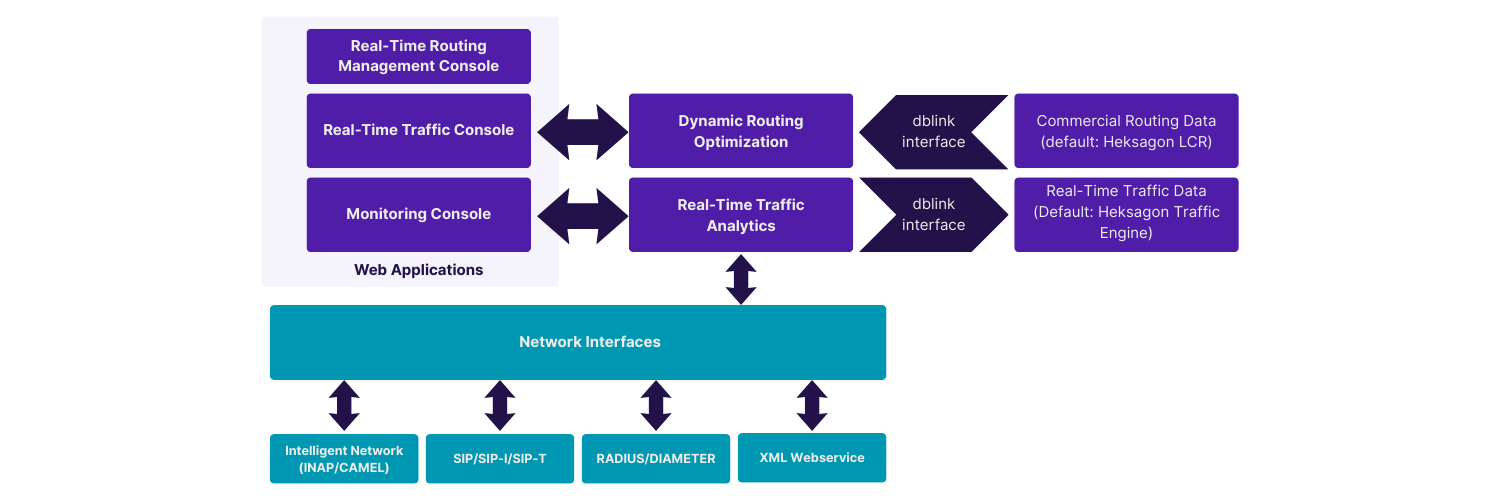
Real-Time Routing operates as an intelligent signaling layer. Within milliseconds, it intercepts call setup requests, evaluates routing options against live business rules and network conditions, and directs calls to optimal carriers. The platform continuously synchronizes with commercial routing calculations, quality monitoring systems, and commitment tracking to ensure every decision reflects current operational reality.
Core Architecture and Performance
The system deploys as redundant, high-availability (N+1) servers handling signaling interfaces (e.g., CAMEL/INAP/SIP). Upon call arrival, the routing engine queries an active database containing current carrier metrics: priorities, pricing, quality, and capacity. The system evaluates applicable rules (margin thresholds, commitment status, time-of-day, etc.) to select the optimal route. This decision is delivered in under 100 milliseconds to prevent call setup delays.
- Scale: Production environments handle 2+ billion daily voice calls with 99.99% uptime. The architecture scales horizontally, managing 160+ switches across multiple time zones.
- Dynamic Routing: State servers maintain real-time aggregates of traffic volumes and quality metrics, enabling analytical routing decisions based on current traffic patterns, rather than only static pricelists.
Functional Independence and Control
Real-Time Routing operates independently of switch hardware and configuration. Unlike technical routing which uploads static tables, this platform makes external decisions via signaling.
- Unlimited Combinations: Eliminates switch hardware limits on routing combination counts (which typically range from 50k–300k), enabling unlimited routing complexity.
- Instant Updates: Integrates with commercial optimization modules for automatic database refresh. Routing changes (from new pricelists or manual overrides) take effect on the very next call without the need for error-prone switch uploads.
- Operator Control: Operators define routing rules via a user-friendly GUI, targeting scenarios by product, carrier, destination, or time. The system logs all routing decisions for complete audit trails.
Financial and Operational Value
The system provides measurable financial benefits and deployment flexibility.
- Cost Savings: Operators report significant daily cost savings post-migration, primarily through negative margin prevention—validating that termination cost does not exceed received revenue on every single call.
- Flexible Deployment: Allows for selective implementation (e.g., applying real-time routing to international wholesale traffic or high-value products with tight margins, while maintaining technical routing for domestic or standard offerings).
- Low TCO: Runs on standard Linux servers, eliminating the substantial switch hardware licensing fees associated with increasing routing combination capacity.
Key Use Cases
| Use Case | Heksagon Capability |
| Wholesale Optimization | Processes 30,000+ daily routing changes across multiple products to maintain optimal carrier selection as pricelists update. |
| Commitment Fulfillment | Tracks volume agreements at a single-call granularity, prioritizing carriers to meet contractual obligations without over-delivery. |
| Automated Quality Failover | Immediately removes carriers whose ASR drops below thresholds and automatically redistributes traffic, verifying recovery before restoration, all without manual intervention. |
| Geographic and Temporal Rules | Executes complex routing strategies automatically based on call origin, destination, and time-of-day factors (peak/off-peak pricing, regional preferences). |
Related Products
Didn't Find What You Were Looking For?
Frequently Asked Questions
What latency does real-time routing add to call setup?
The routing decision process completes in under 100 milliseconds, imperceptible to call quality. Complete call setup including network signaling typically occurs within standard timeframes. Production deployments processing 2+ billion daily calls maintain service level agreements without degradation.
How does real-time routing handle switch or server failures?
The platform deploys in N+1 high availability configuration with automatic failover. If a routing server fails, remaining servers assume the load immediately. If signaling connectivity to switches is lost, most deployments configure fallback to on-switch routing tables as backup, ensuring uninterrupted service.
Can real-time routing coexist with technical routing on the same network?
Yes. Many operators use hybrid models where real-time routing applies to international wholesale traffic or specific products requiring dynamic optimization, while technical routing handles domestic or standard traffic. The systems operate independently with separate signaling paths.
How quickly do routing rule changes take effect?
Immediately. When commercial routing recalculates (due to new pricelists, quality changes, or manual overrides), the real-time routing database updates within seconds. The next call setup request uses the new routing logic, with no batch processing or scheduled updates required.
What happens if real-time routing determines all routes are unprofitable?
The system can be configured to either block the call with a specific release code (preventing negative margin traffic) or allow routing to the least-unprofitable option if business rules prioritize connectivity over margin. This behavior is configurable per product, carrier, or traffic type.
Does real-time routing support number portability and regulatory routing requirements?
Yes. The platform integrates with MNP databases and regulatory numeration data to route based on actual number ownership rather than prefix alone. Routing depth extends to individual numbers, enabling compliance with emergency services routing, premium rate regulations, and local dialing requirements.
Let's Get in Touch
Interested in our Real-Time Routing solution? Fill out the form and our solution experts will contact you in two business days!