
Intelligent Least Cost Routing Solution

Enable Intelligent Cost Optimization of Every Call
Traditional Least Cost Routing (LCR) focuses exclusively on the cheapest per-minute rate. By doing so, it ignores the critical factors that destroy interconnect profitability: low quality (ASR/ACD), wasted capacity on failed calls, and margin erosion due to inefficient commitment usage. Operators relying on price-only routing frequently send high volumes to carriers offering low rates but poor quality (e.g., 40% ASR), leading to customer complaints, revenue loss from failed calls, and increased operational costs for marginal savings.
Our Intelligent LCR platform moves beyond simple price comparison to become your ultimate profit engine. It processes all necessary dimensions simultaneously: real-time quality metrics, dynamic commitment fulfillment status, trunk capacity, and current pricing. The platform automatically determines the optimal routing across millions of combinations, ensuring every call is routed not just to the cheapest path, but to the one that guarantees maximum overall network profitability and meets all service quality requirements.
Heksagon Intelligent Least Cost Routing Features
Our Intelligent LCR operates as a sophisticated analytical engine. It processes complex, multidimensional data to generate routing recommendations balancing multiple, sometimes competing, optimization objectives. The platform supports unlimited routing products with independent optimization strategies, enabling different routing logic for premium services, standard wholesale, national traffic, and international destinations within a single deployment.
Unlimited Scalability
- No hardware constraints: Support 12+ million routing combinations versus competitors limited to 50,000-300,000 by switch hardware
- Selective deployment: Update only affected switches (typically 3-4 out of 160) versus competitors requiring full network updates
- Linux-based architecture: Marginal hardware costs compared to switch licensing fees for equivalent routing capacity
Multi-Factor Routing Optimization
- Maximize Margin: Evaluate carrier pricing, including volume discounts, peak/off-peak rates, and commitment rates, across all active pricelists to find the true lowest cost.
- Promote Quality: Weight Quality metrics (ASR, NER, ACD, PDD) to ensure premium products always prioritize quality over cost, protecting customer experience.
- Avoid Penalties: Optimize Commitments by tracking agreements in real-time, prioritizing unfulfilled volumes while preventing over-delivery that erodes profits.
- Ensure Connectivity: Manage Capacity by considering trunk group availability and utilization to avoid routing calls to carriers that are full during peak periods.
- Enforce Strategy: Integrate Business Rules (priority, block, accept) and manual overrides to enforce commercial strategies beyond automated algorithms.
Advanced Routing Algorithms
- Calculate True Cost: Use Maximum and Real Cost algorithms to determine accurate historical and conservative cost baselines for precise margin calculation and risk management.
- Select Best Value: Deploy Minimum Price algorithms and Approximation Logic to identify the best low-cost options for price-sensitive wholesale products.
- Adapt Logic: Assign Customizable Algorithms per product, destination group, or traffic type to align routing strategy directly with business objectives.
Routing Rule Framework
- Prioritize Strategically: Apply Priority Rules to force specific carriers to designated positions, securing traffic for key commercial relationships.
- Handle Specific Traffic: Use Accept and Block Rules to manage specialized traffic or immediately remove carriers based on defined parameters (e.g., A-number, destination).
- Load Balance: Implement Split Rules to distribute traffic percentage across multiple carriers on the same routing position for controlled load balancing and testing.
- Protect Quality: Utilize Conditional Priority Rules to prevent carriers from dropping below minimum routing positions under specific quality or volume .
Product and Destination Management
- Support All Tiers: Create Unlimited Routing Products (e.g., Premium, Gold, Wholesale) each with independent quality requirements and routing strategies.
- Centralize Data: Manage destinations hierarchically using the Template Destination Table (TDT) for efficient prefix organization and deployment.
- Granular Control: Configure routing algorithms, quality requirements, and rules down to the individual prefix level for detailed fraud prevention or regulatory compliance.
Quality and Performance Monitoring
- Track Performance: Continuously monitor quality (ASR, NER, ACD, PDD) with historical trending to ensure SLA compliance.
- Auto-Block Failures: Use automatic carrier removal to trigger when quality metrics fall below thresholds, protecting service without manual intervention.
- Validate Recovery: Utilize testing automation to trigger verification calls after temporary blocks, validating carrier recovery before restoring them to active routing.
- Predict Degradation: Employ trend-based quality alerts to analyze trends, enabling proactive routing adjustments before service quality thresholds are breached.
How Heksagon Intelligent Least Cost Routing Works
Intelligent LCR operates as a continuous optimization cycle that ingests data from multiple sources like pricelists, quality analytics, commitment tracking, topology. Then, it generates routing recommendations reflecting current operational reality. The platform recalculates routing automatically when any input changes, ensuring routing decisions always use the latest available information.
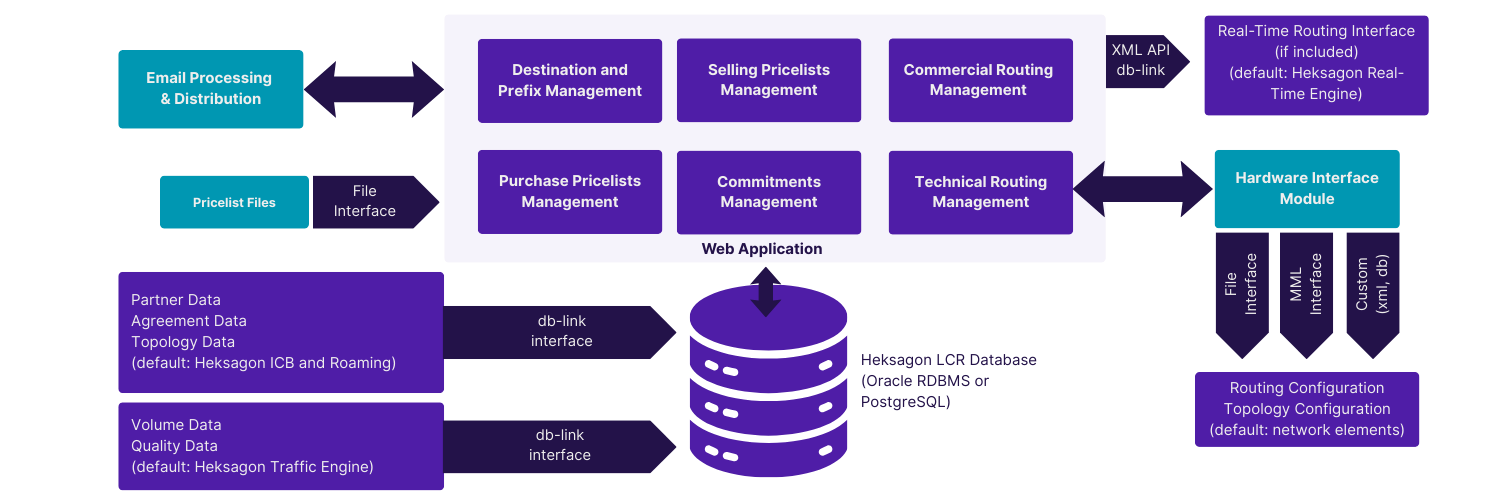
Data Synthesis: The Foundation of Profit
The routing process begins by unifying all critical interconnect data into a single analytical engine. We move beyond simple price lists by continuously collecting and integrating five dimensions of real-time data: Carrier Pricing, Quality Metrics (ASR, ACD, PDD), Commitment Fulfillment Status, Trunk Capacity, and your Configured Business Rules. This holistic data synthesis eliminates the risk of sending traffic to cheap, poor-performing routes that ultimately destroy your margin.
Intelligent Calculation: Dynamic Optimization
For every destination, the routing engine instantly evaluates millions of carrier combinations. It utilizes product-specific optimization algorithms to weigh competing objectives simultaneously:
- Cost vs. Quality: Quality scoring determines if a route meets the service requirements of your specific product tier (Premium, Wholesale, etc.).
- Commitment Priority: Routing is adjusted dynamically to ensure volume obligations are met to avoid hefty financial penalties.
- Capacity Validation: Routing decisions are constrained by real-time trunk availability, guaranteeing calls are never sent to saturated or failing carrier trunk groups.
This automated process generates an optimal carrier priority list that maximizes your profitability for every call type.
Automated Deployment and Business Impact
Intelligent LCR is designed for immediate operational agility. Routing changes are triggered automatically whenever input data changes—a new pricelist, a quality degradation, or an updated commitment status—ensuring your routing always reflects the most current, profitable path.
The system generates precise outputs, including:
- Margin Analysis: Detailed projection reports showing expected profitability by destination.
- Fulfillment Forecasts: Estimates on when volume obligations will be met based on current traffic patterns.
The approved routing is deployed directly via Switch Automation or Real-Time Routing, eliminating manual switch configuration and guaranteeing that optimal routing is live within minutes, not days. This enables daily cost savings and strategic commitment management that is impossible to achieve manually.
Didn't Find What You Were Looking For?
Frequently Asked Questions
What is the difference between Intelligent LCR and Traditional LCR?
Traditional Least Cost Routing selects carriers based only on the lowest price per destination. Intelligent LCR is a profit optimizer. It evaluates multiple factors simultaneously: price, quality (ASR/ACD), commitment fulfillment status, and trunk capacity. This ensures routing maximizes your margin, avoids penalties, and protects service quality, instead of just minimizing cost.
How does Intelligent LCR handle carrier volume commitments?
The system tracks volume agreements and deadlines in real-time. The routing algorithm prioritizes carriers with unfulfilled commitments to meet obligations and avoid penalties. It strictly prevents over-delivery which locks traffic to higher commitment rates when cheaper alternatives are available.
Can I apply different routing strategies to different traffic types?
Yes. The platform supports unlimited routing products, each with independent optimization strategies. You can set Premium services to prioritize quality over cost. Wholesale products can maximize price efficiency within defined quality thresholds. Each product uses its own rules and destination coverage.
How frequently does routing recalculate, and what triggers updates?
Routing can be manual, scheduled, or automatic. Automatic calculation is triggered instantly by data changes. Triggers include new pricelist imports, quality threshold breaches, commitment status updates, or business rule modifications. This ensures your routing always reflects the most profitable path based on real-time market changes.
How does quality monitoring influence routing decisions?
The platform continuously tracks carrier quality metrics (ASR, NER, ACD, PDD). These quality scores are factored into routing with product-specific weighting. When quality drops below a defined threshold, the system triggers automatic removal from routing. This prevents traffic from being sent to failing carriers and preserves customer experience.
What happens when calculated routing conflicts with business requirements?
Your Business Rules always override algorithmic optimization. Priority rules ensure specific carriers are always used for strategic relationships. Block rules prevent traffic due to commercial issues. Manual overrides allow immediate, urgent routing adjustments. This guarantees your commercial strategy retains final control over the network.
Let's Get in Touch!
Interested in our Intelligent LCR solution? Fill out the form and our solution experts will contact you in two business days!