
Smart Telecom Mediation Solution

Turn Raw Data into Billing Accuracy
Raw CDRs from switches, gateways, and service platforms arrive in dozens of formats, each with different field structures, inconsistent timestamps, and missing critical data. When records for the same call appear multiple times across network elements or contain errors, manual correction delays billing by days, leaving revenue uncaptured. Incomplete topology mapping and missing rate information prevent accurate charging, forcing finance teams into endless reconciliation cycles.
Heksagon's Smart Mediation gives you clean, normalized, billable records ready for rating and invoicing in near-real-time.
Heksagon Smart Mediation Features
Our Smart Mediation Solution ingests CDRs from any source regardless of format, validates data integrity, merges duplicate records automatically, and enriches it with topology, pricing, and business context.
Universal Data Collection & Validation
Ingest CDRs from any network element via FTP/SFTP, database links, or near-real-time feeds. Support all standard formats (ASN.1, IPDR, CSV) plus custom proprietary formats through flexible parsers. Validate completeness and integrity immediately, catching corrupt files, missing mandatory fields, and logical inconsistencies before they contaminate billing.
Intelligent Processing & Enrichment
Automatically merge duplicate records from distributed switches into single billable events. Normalize inconsistent data (timezone conversions, number formatting, duration calculations). Enrich with business intelligence: map trunks to carriers, apply MNP data for correct destination routing, add topology context, and pre-rate for immediate margin visibility.
Quality Assurance & Reprocessing
Detect anomalies through pattern analysis of duplicate call attempts, impossible durations, and suspicious number patterns. Support selective reprocessing when prices or topology change, updating only affected records rather than reprocessing entire datasets. Maintain complete audit trails showing every transformation from raw input to final output.
How Heksagon Interconnect Smart Mediation Works
Heksagon Smart Mediation operates as your data quality engine, continuously transforming chaotic network data into the structured, accurate foundation that all downstream revenue operations depend on.
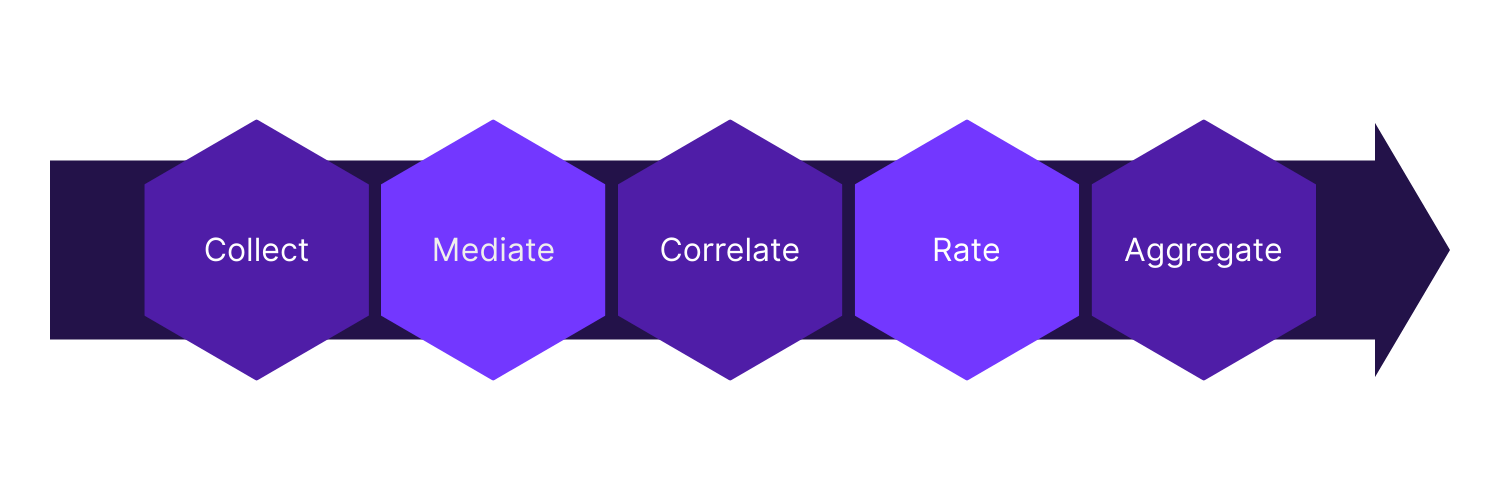
Collection to Normalized Output
- Automated Collection: Agents monitor designated sources continuously, pulling CDR files as they arrive. Validation checks file integrity and structure before processing begins, preventing corrupt data from entering the pipeline.
- Processing Engine: The core processor executes configured transformation rules: parsing source formats, validating mandatory fields, merging duplicate records across network elements, normalizing data formats (dates, numbers, durations), and correlating related records supported by source systems (e.g., multiple partial CDRs).
- Enrichment Layer: Processed records gain business context through integration with Partner Management for carrier identification, Template Destination Tables for destination mapping, MNP databases for number portability resolution, and Intelligent LCR for routing cost assignment.
Quality Control & Delivery
- Pre-Rating Validation: Before records flow to billing, automated checks verify that all rating prerequisites exist: valid destination, identified carrier, correct topology mapping, and applicable pricing. Records failing validation trigger alerts for investigation rather than generating incorrect invoices.
- Aggregation & Distribution: Validated records aggregate according to configured schedules (typically 5-15 minute intervals), feeding multiple consumers simultaneously: Billing Process for invoice generation, Commercial Analytics for traffic analysis, fraud detection systems for security monitoring, and data warehouses for long-term intelligence.
Frequently Asked Questions
How does Smart Mediation handle multiple CDR formats from different vendors?
Template-based parsing defines format specs for every source without custom coding. The system automatically applies the correct template (ASN.1, CSV, proprietary, etc.), normalizing all formats into a unified structure.
What happens when the same call generates CDRs from multiple network elements?
Intelligent correlation merges duplicate records into a single billable event. The system identifies related records using call identifiers and timestamps, consolidating them with configurable logic to prevent duplicate billing.
Can mediation reprocess historical data when pricing or topology changes?
Yes. Selective reprocessing targets specific periods, carriers, or destinations. When our Intelligent LCR updates prices or topology changes affect routing, the system re-rates only affected records, enabling quick margin recalculation without full pipeline reprocessing.
How quickly does processed data become available for billing and analytics?
Near real-time delivery with configurable intervals. Default 5-15 minute processing cycles ensure CDRs are normalized, enriched, and available to the Billing Process module quickly, minimizing revenue recognition delays.
What quality controls prevent billing errors from bad data?
Multi-layer validation catches issues at collection (file integrity), processing (logical consistency, duplicate detection), and pre-rating (pricing availability). Records failing any stage are quarantined for investigation, preventing incorrect charges.
How does the system handle peak traffic periods without performance degradation?
A horizontally scalable architecture scales across distributed processing nodes to maintain consistent performance during peak traffic. Processing scales dynamically to maintain consistent processing times regardless of volume.
Let's Get in Touch
Interested in our Real-Time Routing solution? Fill out the form and our solution experts will contact you in two business days!