
Least Cost Routing in Telecom: How It Works and Why Real-Time Routing Is Replacing Static Rate Tables
Every outbound call your network carries has a cost. The cost depends on which carrier terminates it, and which carrier terminates it depends on how your routing system is configured. Least Cost Routing (LCR) is the discipline of making that configuration work in your favor: selecting the lowest-cost technically acceptable route for each call, across all available carriers, for every destination your network serves.
In principle, LCR is simple enough. In practice, it is one of the most operationally demanding functions in interconnect management, and the gap between how most operators run it and how it can be run is where margin quietly disappears.
Published:

How Static LCR Works
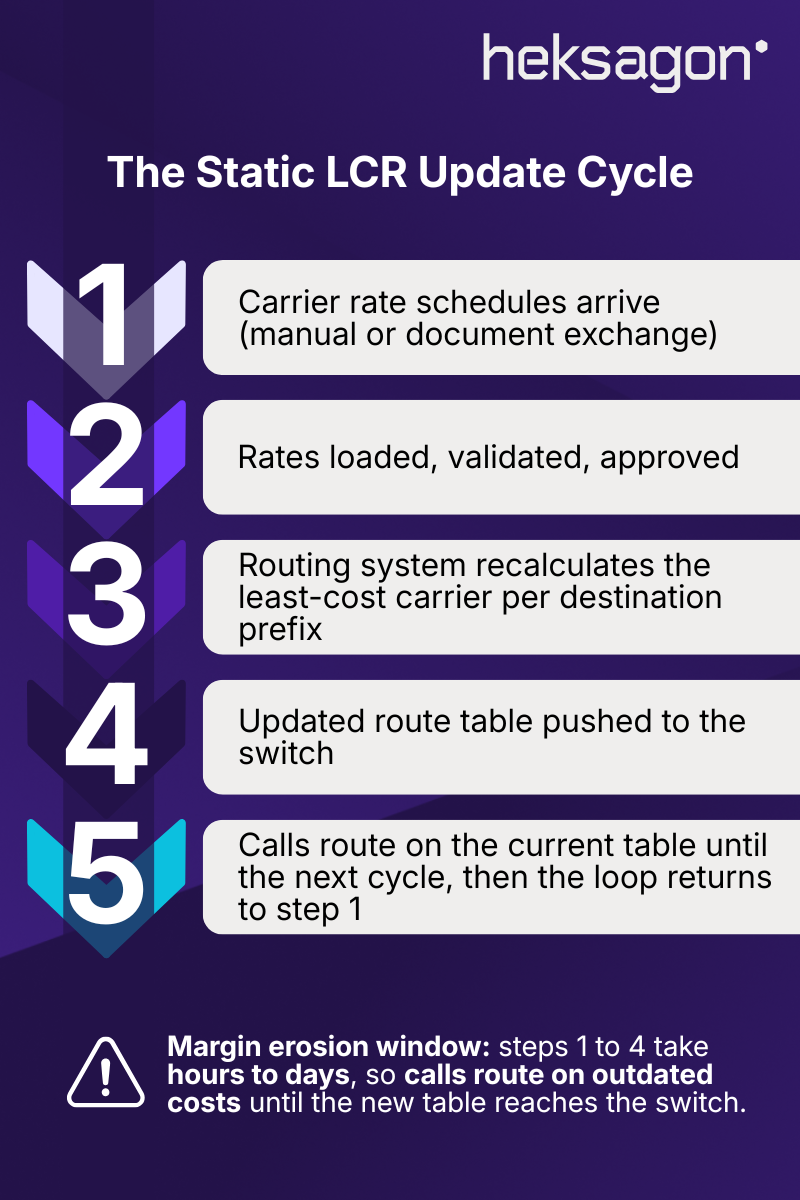
Static LCR is the approach most operators inherited with their interconnect platforms. The process follows a predictable cycle.
Your routing team receives updated rate schedules from carriers, manually or via document exchange. Those rates are loaded into the routing system, which recalculates the least-cost carrier for each destination prefix based on the new tariffs. The updated route table is then pushed to the switch. Calls route according to the new table until the next update cycle.
The appeal of this approach is its simplicity. The routing logic is transparent and auditable. The switch configuration is stable between update cycles. The team controls the process.
The problem is timing. Carrier rates change continuously: price increases, promotional discounts, short-term offers with narrow validity windows. Between the moment a new rate schedule arrives and the moment it is loaded, validated, approved, and pushed to the switch, time passes. On a busy interconnect desk, that cycle can take hours or days. During that window, the routing system is operating on outdated information. Calls that should route to a cheaper carrier continue routing to a more expensive one. The margin erosion is invisible in real time and only becomes visible in the next billing reconciliation.
Where Static Tables Break Down at Scale
The timing gap is the most obvious problem, but it is not the only one.
- Quality degradation goes undetected: A static routing table selects the cheapest route based on cost alone. If a carrier's Answer Seizure Ratio (ASR) drops because of a technical problem, congestion, or route degradation, the routing table does not know it. Calls continue to flow to a carrier that is completing a declining percentage of them. The operational consequence is that your network's effective completion rate falls with it, and the commercial consequence is that your subscribers experience failed calls on routes where a better-performing alternative exists.
- Cherry-picking exploits your static configuration: When carriers know your routing logic is updated infrequently, they can price strategically to win high-value destination traffic at rates that look competitive on paper but are optimized for their margin rather than yours. A carrier that wins a destination with a promotional rate and then raises it at the next cycle counts on the lag between rate change and routing update to protect that position.
- Negative margin goes uncontrolled: An operator that sells traffic to enterprise customers at agreed rates and routes it to carriers based on a rate table that does not reflect current purchase costs can inadvertently carry traffic at a margin below zero. This happens when purchase rates change between routing updates and the routing system has not been updated to reflect the new cost baseline. Each affected call costs more to terminate than it earns. At volume, the losses compound quickly before the next reconciliation catches them.
What Real-Time LCR Does Differently
Real-time LCR makes the routing decision per call, using current data, rather than per update cycle using the most recent table load.
Per-call routing with immediate rate execution
Each outbound call is evaluated at setup time against current carrier rates, including rates that arrived since the last manual update. There is no lag between a new rate taking effect commercially and the routing system applying it. The cheapest currently available route for each destination is always the route selected.
Automatic re-routing triggered by ASR drops
Real-time LCR continuously monitors completion rates by carrier and destination. When a carrier's ASR falls below a configured threshold, the system automatically re-routes traffic away from that carrier without waiting for a manual intervention. Call quality is maintained in real time rather than recovered after subscriber complaints.
Negative margin control
The system calculates the margin on each call before routing it. If the available routes for a destination would result in a negative margin given the current selling rate, the system can apply a configurable response: route to an alternative carrier, flag the destination for commercial review, or hold traffic pending rate negotiation. Margin is a routing input, not a post-event reconciliation item.
Cherry-picking prevention
Because routing decisions use live rate data, a carrier that attempts to win traffic with a below-cost promotional rate and then raise it faces immediate re-routing as soon as the rate change is detected. The static-table vulnerability that made cherry-picking viable is removed.
Switch Automation: Closing the Last Gap
Real-time LCR that calculates the optimal route but still requires manual switch updates to implement it retains the execution lag that creates margin erosion. Full switch automation closes that gap.
Switch automation means that routing decisions made by the LCR engine are executed directly on the switch without a manual configuration step. When the system determines that traffic to a destination should move from one carrier to another, that change propagates to the switch automatically, across all configured network interfaces simultaneously. The route change is live in seconds rather than hours.
For interconnect teams that manage large routing tables across multiple switches, the operational benefit extends beyond margin protection. The time currently spent on manual route table updates becomes available for commercial and analytical work. This involves reviewing carrier performance, negotiating rates, analyzing traffic patterns, and identifying new routing opportunities.
From Theory to P&L: What Real-Time LCR Delivers in Practice
The operational case for real-time LCR is easy to make on paper. What it looks like on an actual interconnect P&L is a different question.
| Automated Switch Interface | Real-Time |
| Automated application of routing configuration | Full process automation and carrier quality testing |
| Reconciliation of switch configuration with commercial routing ("real-routing“) | Negative Margin control and “cherry picking“ prevention |
| Intelligent trunk group topology processing | Immediate reaction on quality drop (ASR-0) |
| Optimal application of technical routing on any network topology | Automatic re-route on delivery issue (SMS) and commitment tracking to the level of single call/SMS |
| Prevention of routing faults (loopback, etc.) | Support of all used core network interfaces (SIP, CAMEL, ISC SIP, SS7, ...) |
| Limited number of routing combinations (HW, license) | Unlimited number of routing combinations |
Heksagon's Intelligent Least Cost Routing covers all four functional areas described in this post:
- Per-call routing with immediate rate execution
- Quality-based re-routing triggered automatically by ASR threshold breaches
- Margin control as a live routing input
- Switch automation that executes routing decisions across all network interfaces without manual steps
The platform integrates with Heksagon's Comprehensive Interconnect Billing system, so routing data and billing data share a common CDR foundation and discrepancies surface in the billing workflow rather than in a separate reconciliation exercise.
Telekom Slovenije recently used Heksagon solutions to overhaul its interconnect billing and routing systems. They found that the gains extended beyond operational efficiency. Bojan Vene, Head of International Carriers at Telekom Slovenije, described the outcome directly:
"The improved efficiency and reliability of the billing and routing processes directly contributed to an uptick in our revenue. With the new system's detailed analytics and reporting features, Telekom Slovenije is better positioned to negotiate favourable terms in interconnect agreements and commitments, leveraging data-driven insights to secure competitive rates."
That last point captures the compounding benefit of real-time routing visibility that static tables cannot provide: the same system that optimizes routing per call also generates the evidence base your commercial team needs at the negotiating table.
The Bottom Line
Static LCR was a workable approach when rate changes were infrequent, carrier counts were manageable, and margin sensitivity was low enough to absorb the lag between update cycles. None of those conditions reliably hold in today's wholesale voice market.
Static routing has four failure modes: delayed rate execution, undetected quality degradation, uncontrolled negative margin, and carrier cherry-picking. They are structural features of an architecture that evaluates routes on a schedule rather than per call. Real-time LCR, quality-based re-routing, margin control, and switch automation each address one of those failure modes directly. Together they replace the conditions that make margin erosion possible with a routing layer that responds to the network and the market as they actually are, not as they were when the last table was loaded.
If you are still building the internal case for real-time LCR, the Telekom Slovenije case study is the right next read. If you are already in vendor evaluation, consider speaking with Heksagon about what a routing architecture review looks like for your network.
Related Reading:
-
What Is Interconnect Billing? A Guide for Telecom Operators
Routing and billing share the same CDR foundation. See the billing side of interconnect before or after this one.
-
The Telekom Slovenije Story: How Data-Driven Routing Transformed Interconnect Negotiations
The same case study, told from the negotiating table: learn how real-time routing data changed what Telekom Slovenije could ask for in interconnect agreements.