
Inventory Management Software
Gain a single, centralized view of every network resource, physical, logical, and service. Handle complex, multi-vendor, multi-technology environments through a flexible template model. Define new element types and technologies as configuration changes with resource reservation planning built in.
Inventory Management Software Benefits

One Source of Truth
Physical, logical, service, and location inventory live in a single platform, replacing the fragmented legacy systems most operators run today.

Configuration First
Add new network elements, vendors, and technologies through the template model, on your schedule instead of a vendor release cycle.

Resource Reservation
Reserve ports, connections, and capacity ahead of allocation, so parallel provisioning and migration workflows never commit the same resource twice.

Live Deployments
Reference deployments show measurable gains in activation speed and inventory accuracy after switching from legacy systems.
Inventory Management Software Features
The platform covers data modeling, feasibility, automation, visualization, and integration in one system. Every capability reads and writes the same inventory records, so a change you make in one place is reflected across the board.
Network Resource Inventory and Element Modeling
Tracks passive infrastructure, active network elements, terminal equipment, and logical resources in one template-based data model. Templates cover simple elements and modules as well as hierarchies for complex ones, including internal structure (rack, shelf, board), site configuration, and geographic hierarchy. Ports support unlimited creation and point-to-point, point-to-multipoint, ring, and cloud connections.
Product, Service, and Connection Mapping
Connects customer-facing products and technical services to the access and logical connection templates that deliver them, and describes how each customer is connected across the full service path.
Service Feasibility Function
Evaluates service availability, identifies the serving node, checks port and resource availability, and determines which technologies are feasible at a given location before an order is accepted.
Resource management and Reservation Planning
Tracks current allocation of ports, connections, and access resources, and utilization across services. Resource reservation planning holds capacity for pending orders, planned network builds, and migrations before it is committed, so parallel provisioning workflows don't claim the same resource. Maintenance and failure statistics are tracked alongside allocation data.
Auto-Discovery and Network Alignment
Retrieves physical configuration data directly from the network, keeps inventory records aligned with what is actually deployed, and detects changes in network elements.
Visual Workflow Builder
Automates feasibility and access-point assignment, service activation, change, and deactivation, planned and corrective maintenance, and bulk or group switchovers such as large-scale technology migrations, with human review built in for ambiguous or high-impact steps.
Visualization, Hierarchy, and Reporting
Automates feasibility and access-point assignment, service activation, change, and deactivation, planned and corrective maintenance, and bulk or group switchovers such as large-scale technology migrations, with human review built in for ambiguous or high-impact steps.
Integration and Data Control
Connects to network-side systems through discovery and synchronization and to CRM, billing, and ERP on the business side, so inventory data and feasibility decisions flow across the OSS/BSS stack. Defined data ownership, reconciliation between sources, and audit-tracked updates keep records consistent as they move.
How Does Heksagon's Inventory Management Software Work?
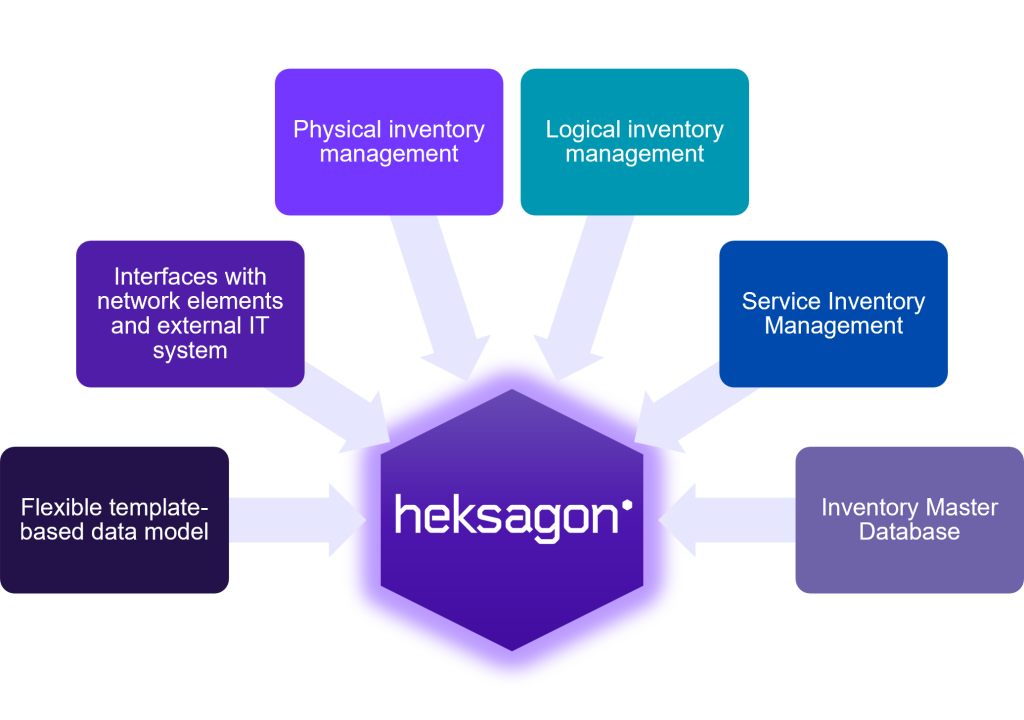
The platform starts by modeling your network through its template-based data model, defining simple elements directly and complex ones through hierarchies of racks, shelves, boards, and sites. Auto-discovery then keeps that model aligned with what is actually deployed, retrieving physical configuration data from the network and detecting changes in network elements.
From there, the Service Feasibility Function checks port and resource availability and identifies which technologies are available at a given location, and the Visual Workflow Builder carries that decision through to execution: assigning access points, activating or changing services, and triggering downstream work orders for field and provisioning teams. Resource reservation planning sits underneath all of this, holding capacity for anything already committed so two workflows never claim the same port or connection.
Integration adapters connect the platform to your existing network-side systems, CRM, billing, and ERP, so it becomes the shared inventory layer across OSS and BSS instead of another system your teams reconcile by hand.
How to Use Heksagon Inventory Management
| Replacing a legacy inventory platform | Building OSS/BSS from the ground up |
| Migrate existing physical, logical, and service records into a single, template-based model | Define network elements and technologies as they're deployed, without waiting on custom development |
| Reconcile legacy data against auto-discovered network state before cutover | Connect feasibility and activation to sales and provisioning from day one |
| Phase delivery to limit risk during cutover | Set up resource reservation planning before order volume makes manual tracking unreliable |
| Keep existing CRM, billing, and field-service systems in place through the integration layer | Build a single source of truth as the network scales, instead of retrofitting one later |
Didn't Find What You Were Looking For?
Frequently Asked Questions
What does Heksagon's Inventory Management solution cover?
Physical inventory (cables, routers, cards, ports), logical inventory (including IP addresses), service inventory (including SIM resources), and location inventory (sites, buildings, rooms, racks), all in one data model.
Does it replace our existing CRM, billing, or field-service systems?
No. It integrates with network-side systems through discovery and synchronization, and with CRM, billing, and ERP on the business side, so those systems keep doing their job while inventory becomes the shared source of truth between them.
How does resource reservation planning work?
It holds ports, connections, and capacity for orders, builds, or migrations that are already committed but not yet executed, so a separate workflow can't allocate the same resource in the meantime.
Can it model technologies you don't support out of the box?
Yes. The template-based data model is built for defining new element types and technologies through configuration, not a development project.
How long does implementation typically take?
Implementation is phased and scoped to your environment. A full migration from a legacy inventory system, including data migration and consolidation, has been completed in as little as 8 months in a live production deployment.
Do you support multi-vendor, multi-technology networks?
Yes. The platform is built for environments with multiple technologies, vendors, and interconnection schemes, including access-technology migrations such as DSL to GPON.
Let's Get in Touch!
Interested in Heksagon's Inventory Management solution? Fill out the form and our solution experts will contact you in two business days.