
The Telekom Slovenije Story: How Data-Driven Routing Transformed Interconnect Negotiations
Most Heads of Interconnect negotiate with one hand tied behind their back. The reason is not a lack of skill or market knowledge. It is a lack of data. When rate analysis is manual, route performance visibility is incomplete, and commercial reporting lags behind operational reality, even the most experienced negotiator is making decisions on partial information. Telekom Slovenije recognized this problem and decided to solve it at the infrastructure level.
Published:

The Starting Point: Manual Processes, Limited Visibility
Telekom Slovenije is a leading fixed and mobile operator serving both retail and wholesale customers across Slovenia. With a diverse portfolio that includes voice, data, mobile, and ICT services, the company manages a vast network with hundreds of interconnect partners. Each partner brings its own set of rates, terms, billing cycles, and commercial agreements.
Before the transformation, the interconnect billing and routing infrastructure ran on legacy systems that had been in place for years. The operational friction points were well known to the carrier team. Interconnect agreements were complex and demanded careful attention, but the existing system offered limited support for managing them. Cost control was difficult because financial visibility was fragmented. Reporting data was not available in near real-time, which meant both commercial and technical users made decisions on information that was already aging.
One specific bottleneck was the manual nature of certain recurring tasks. Pricelist imports, error handling, and commitment tracking required significant human intervention. Each manual touchpoint introduced the possibility of delay and error. When disputes arose, and, in interconnect billing, they always arise, the team had to reconcile without a centralized view of quality and commercial metrics.
For Bojan Vene, Head of International Carriers at Telekom Slovenije, the core challenge was not operational. It was commercial. When his team sat across the table from an interconnect partner, they had to negotiate rates, commitments, and terms using data that was incomplete. The analytics existed, but they were dispersed across systems and reports. Assembling a coherent negotiating position took time and left gaps that experienced counterparties could exploit.
The Flaws of Manual Rate Analysis
The problem Telekom Slovenije faced is not unique. It is structural to how interconnect operates at scale.
Every interconnect agreement contains rate tables that span destinations, time bands, and quality tiers. A mid-sized European operator might manage hundreds of these agreements simultaneously. When a partner proposes a rate change, the operator must assess the impact across its entire traffic profile. That assessment requires knowing how much traffic terminates at each destination, what the current cost base is, what quality thresholds are being met, and what margin the traffic currently generates.
With manual processes, this analysis takes days or weeks. The negotiator requests a report. The report is compiled from multiple systems. By the time it arrives, the market may have moved. The partner's proposed rate may have expired. The operator's negotiating position is built on backward-looking data, while the counterparty is negotiating on current market conditions.
The same dynamic applies to commitment agreements. Minimum volume commitments are a standard feature of interconnect contracts, but tracking them requires continuous monitoring of traffic volumes against contractual thresholds. With fragmented reporting, shortfalls are discovered after the commitment period ends, when the operator owes a shortfall payment it did not see coming.
These are not process problems. They are data infrastructure problems. And they are solved at the infrastructure level or not at all.
From Fragmented Reporting to a Single Data Layer
Telekom Slovenije undertook a thorough evaluation of Interconnect Billing and Least Cost Routing solutions. The selection criteria prioritized technical capability, scalability, flexibility to adapt to market shifts, and integration with the existing infrastructure without disruption.
The solution implemented included three capabilities that directly addressed the negotiation data gap. Intelligent Least Cost Routing replaced static rate tables with real-time routing decisions, optimizing for cost while maintaining quality thresholds. Automated Interconnect Billing streamlined the billing cycle, reducing manual interventions and accelerating revenue recognition. And critically for the carrier team, a unified analytics layer brought together technical and commercial data that had previously lived in separate systems.
The operational results were measurable. Manual interventions in billing processes dropped by a significant percentage. Discrepancies and disputes decreased. Revenue recognition became more accurate and timely. Real-time routing optimizations reduced interconnect traffic costs, improving margins on wholesale services.
But the result that matters the most for this story is the one that changed the negotiating dynamic.
The Data-Driven Negotiation
With the new system in place, Telekom Slovenije's carrier team gained access to detailed analytics and reporting that had not existed in the previous infrastructure. Traffic patterns, route performance, cost trends, and margin analysis became available in near real time, not as a historical report compiled days after the fact.
This changed how negotiations were approached. Instead of entering a rate discussion with a general sense of market conditions and a backward-looking report, the team could access current data on exactly how much traffic was terminating to each destination, what the quality metrics showed, and what margin impact a proposed rate change would produce.
Bojan Vene described the commercial outcome: "The improved efficiency and reliability of the billing and routing processes directly contributed to an uptick in our revenue. With the new system's detailed analytics and reporting features, Telekom Slovenije is better positioned to negotiate favorable terms in interconnect agreements and commitments, leveraging data-driven insights to secure competitive rates."
That is the commercial output of getting the data infrastructure right. The negotiation itself still depends on the skill of the carrier team. The difference is that the team now has the information it needs to negotiate from a position of strength.
"The improved efficiency and reliability of the billing and routing processes directly contributed to an uptick in our revenue. With the new system's detailed analytics and reporting features, Telekom Slovenije is better positioned to negotiate favorable terms in interconnect agreements and commitments, leveraging data-driven insights to secure competitive rates."
Bojan Vene Head of International Carriers, Telekom Slovenije
The Solutions Behind the Outcome
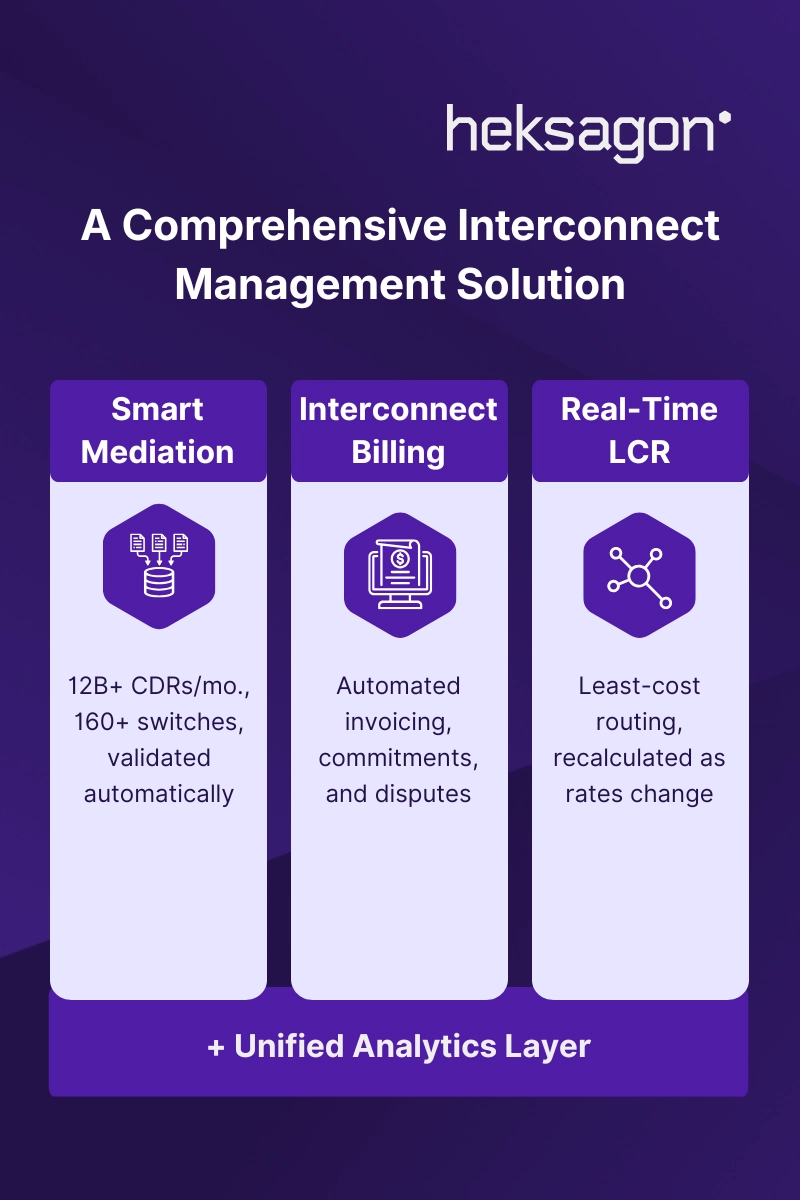
The analytics layer that supports data-driven negotiation depends on mediation, billing, and routing systems that process data accurately and deliver it in time to be commercially useful. Telekom Slovenije's implementation combines three capabilities that work together to produce the unified view the carrier team now relies on.
Smart Mediation normalizes and enriches CDR data from across the network, processing over 12 billion CDR records per month and integrating with more than 160 switches. This is the foundation. If mediation data is incomplete or delayed, every downstream analysis is compromised. Comprehensive Interconnect Billing automates the billing workflow, from data collection through invoicing, commitment tracking, and dispute management. When billing is automated, the carrier team spends less time reconciling and more time negotiating. Real-Time LCR replaces static rate tables with dynamic routing that optimizes for cost and quality in real time, ensuring that the rates negotiated are the rates enforced at the network level.
The Key Takeaway for Carrier Teams
The Telekom Slovenije story validates a principle that applies to any operator managing a complex interconnect environment: negotiation advantage comes from data infrastructure, not from negotiation tactics.
Carrier teams that negotiate with complete, current data secure better rates. They identify commitment shortfalls before they become financial penalties. They detect partner behavior patterns that manual analysis would miss. They build negotiating positions on facts rather than assumptions.
The operators who invest in the mediation, billing, and routing infrastructure that makes this possible will be the ones whose carrier teams negotiate from strength. The ones who leave their teams with fragmented reporting and manual processes will continue to negotiate with one hand behind their back. If your interconnect team is struggling with manual rate analysis, limited visibility into route performance, or negotiations based on incomplete data, get in touch to see how Heksagon can help.
This story was originally featured in Mobile World Live, in partnership with GSMA, in 2024.