
SS7, Diameter, GTP, and SIP: Signaling Vulnerabilities and Their Business Impact
Most telecom fraud management conversations start with traffic: spoofed calls, inflated volumes, IRSF patterns. The bigger risk lies lower, in the signaling protocol layer carrying that traffic. If that layer gets exposed, fraud losses are a question of when and how much.
This is a business overview of the risk each signaling protocol (SS7, Diameter, GTP, and SIP) carries and why covering one layer and leaving another open creates a structural gap.
Published:
Why Signaling Is the Right Place to Start
Before a call connects, an SMS arrives, or a roaming subscriber authenticates on a foreign network, signaling protocols handle the setup. Every revenue-generating subscriber action passes through this control plane.
These protocols were designed decades ago, when every network on the global signaling ecosystem was assumed to be trustworthy. That assumption no longer holds. Anyone from fraud groups to unauthorized surveillance services can exploit the same architectural gaps if they gain access to the signaling network.
The signaling attack surface for most operators includes SS7, Diameter, GTP, and SIP.
| Protocol | Home network element | Interface | Border control point | Crosses |
| SS7 | HLR, MSC/VLR (2G/3G) | MAP over SIGTRAN | STP with SS7 firewall | Roaming partners over SS7 interconnect and IPX |
| Diameter | HSS, MME (4G LTE) | S6a, S6d | Diameter Edge Agent (DEA) | Roaming partners over IPX |
| GTP | SGW/PGW, GGSN (mobile data) | Gn, Gp, S5/S8 | GTP firewall at the GRX/IPX edge | Visited networks' data tunnels |
| SIP | IMS core (VoLTE, VoWiFi) | SIP trunks | Session Border Controller (SBC) | Public Internet and IP interconnect |
| 5G HTTP/2 | 5G core (UDM, AMF) | N32 | Security Edge Protection Proxy (SEPP) | 5G Standalone roaming partners |
SS7: Location Tracking and Call Interception
SS7 (Signaling System No. 7, or Signalling System No. 7 in ITU usage) was standardized in the 1970s for circuit-switched networks. It remains the backbone of 2G and 3G voice and SMS and carries roaming and call-routing signaling across most global networks. A subscriber on a 5G handset can still be reached over SS7 if their operator or a roaming partner runs legacy infrastructure.
SS7 was built on mutual trust. Any connected operator can send messages to any other, and nothing authenticates where a message came from. A request from a legitimate operator looks identical to one from a compromised node or from someone who has bought access to the signaling network.
That open trust model makes three kinds of attacks possible.
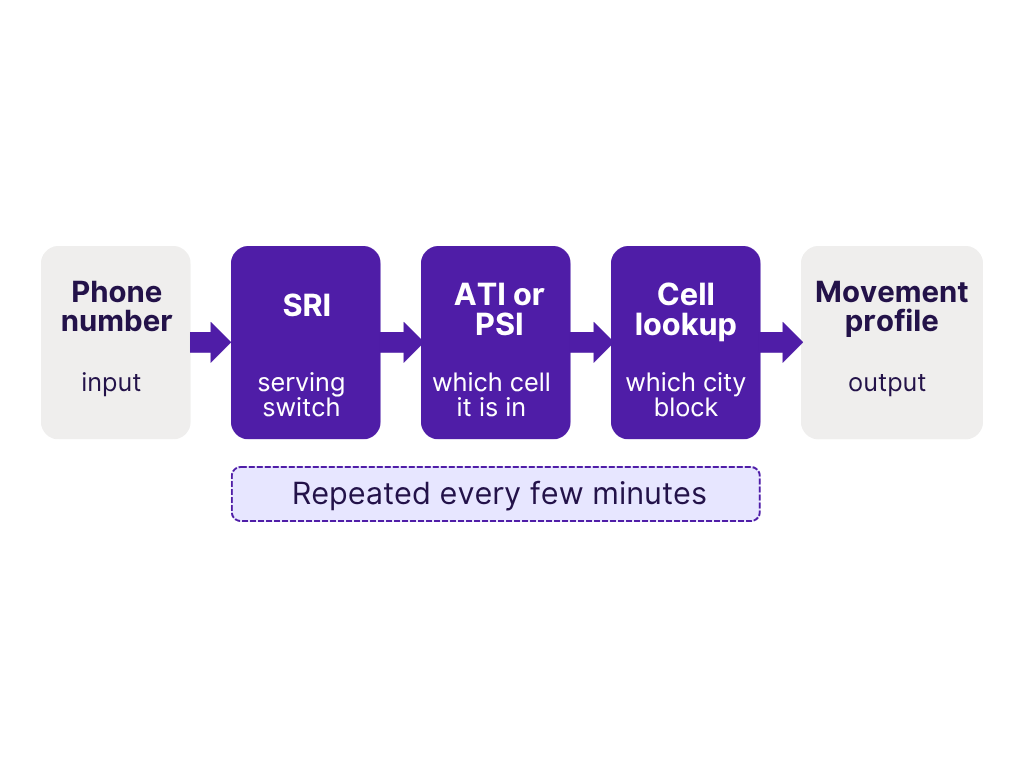
- Location tracking is the most widely documented. It relies on three SS7 messages, ProvideSubscriberInfo (PSI), AnyTimeInterrogation (ATI), and SendRoutingInfo (SRI), chained together to build a near-real-time location profile. In a city, cell-level precision can place a subscriber within a block. Saudi Arabia's three largest mobile operators were documented using this technique to track Saudi nationals traveling in the United States. The same method has been used against journalists, diplomats, and corporate executives across multiple continents.
- Call interception takes more work but has been demonstrated. An attacker with signaling access can inject routing instructions that send voice traffic through a node they control. Both parties hear a normal call, but it’s the attacker that records it.
- SMS interception is the attack most likely to reach ordinary subscribers. A forged UpdateLocation message lets an attacker register the victim's number to a node they control and receive that subscriber's SMS traffic, including the one-time passwords banks and online services use for two-factor authentication. In 2017, criminals used this route to drain the bank accounts of O2 Telefónica customers in Germany.
The business exposure:
A single confirmed location breach involving a high-profile subscriber triggers regulatory notification obligations, potential GDPR or equivalent liability, media coverage, and lasting damage to subscriber trust. Regulators know these vulnerabilities have been public for years, and they expect operators to have closed them.
Diameter: LTE Roaming Manipulation
Diameter was built as the signaling protocol for 4G LTE, with support for TLS and IPsec. In most deployed networks, though, those protections are optional and often not enforced on roaming interconnect paths.
Exposure is highest in roaming, where the home and visited networks exchange authentication and session data over Diameter. The Diameter Edge Agent (DEA) sits at the operator boundary and is the first stop for inbound signaling from roaming partners.
An attacker who can inject messages at the DEA can extract subscriber profile data including the IMSI, alter quality-of-service parameters to degrade service for specific subscribers, or overload the Home Subscriber Server (HSS), which authenticates the entire subscriber base. Manipulated InsertSubscriberData (ISD) messages can also plant false profile entries in a visited network. Researchers have documented actors running Diameter probes alongside SS7 queries and rotating signaling identities across both to hide the attack's origin.
The business exposure:
Moving to LTE only expanded the attack surface. An HSS overload degrades roaming service for every affected subscriber at once. Targeted subscriber data extraction fuels social engineering, account takeover, and VIP targeting. Regulators in the EU and several Middle Eastern markets now treat Diameter signaling security as a compliance expectation. An operator with dozens to hundreds of active roaming agreements has that many Diameter interconnect paths to secure.
GTP: Data Tunnel Abuse and Roaming Fraud
GTP (GPRS Tunneling Protocol) gets less attention than SS7 or Diameter, but it carries the data plane for 3G and 4G networks and is actively exploited. It tunnels subscriber data sessions during roaming, and like the older protocols, it was built without security in mind.
GTP attacks target tunnel endpoints on the Gn, Gp, and S5/S8 roaming interfaces. By manipulating tunnel parameters, attackers can access subscriber data sessions, open fraudulent tunnels that bill traffic to legitimate subscribers, or overload GGSN and PGW nodes. Where data roaming rates are high and detection relies on post-event CDR analysis, GTP roaming fraud is a significant loss vector.
The business exposure:
GTP fraud losses typically accumulate quietly. Each fraudulent session looks like a legitimate roaming data session, so it passes through billing without raising an alert. Detection depends on behavioral analysis and real-time tunnel inspection, neither of which is available in a CDR-only fraud management stack.
SIP: Voice DDoS and CLI Spoofing
SIP (Session Initiation Protocol) runs the VoIP and IMS layer, setting up and ending voice and video sessions for VoLTE, VoWiFi, and IP interconnect. Unlike SS7 and Diameter, which run over private interconnect networks, SIP is reachable directly from the Internet, and most of its risk follows from that.
Voice DDoS attacks flood SIP interfaces with malformed or excessive call setup requests until Session Border Controllers can no longer complete legitimate calls. They are cheap to launch and can degrade voice service for large subscriber populations within minutes. The operator pays in engineering time, support volume, and, if the outage crosses reportable thresholds, regulatory notification.
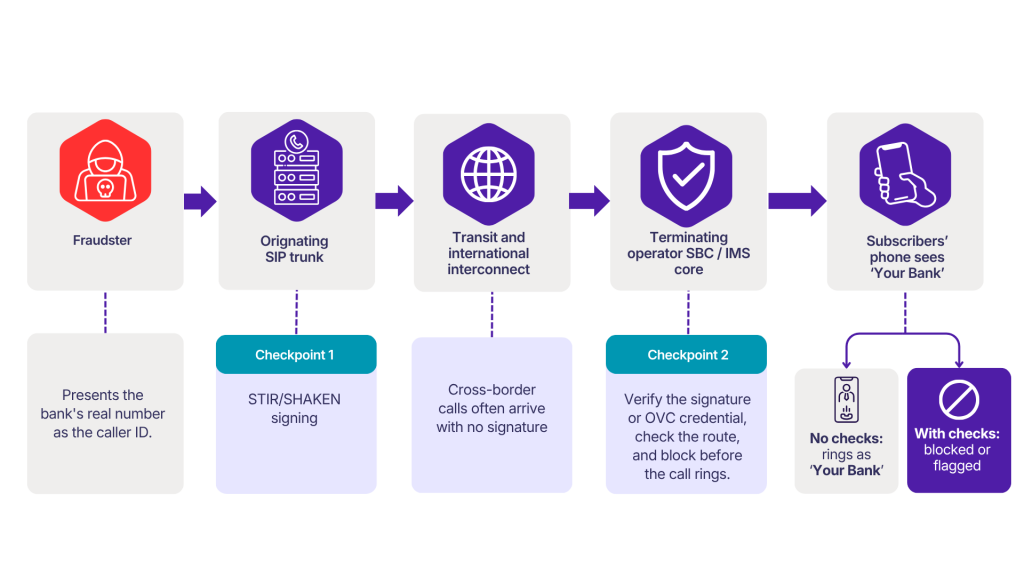
CLI spoofing is the other main SIP threat. SIP lets a caller present any number they like as the calling line identity. This is the signaling-level mechanism behind most vishing campaigns, brand impersonation calls, and bank fraud attempts that reach a subscriber with a trusted-looking caller ID. Because the SIP session itself is valid, the call has to be inspected and stopped at the SIP layer before it reaches the subscriber.
The business exposure:
When a subscriber loses money to a call that appeared to come from their bank, CLI spoofing becomes a fraud, regulatory, and reputation problem for the operator that delivered it. A growing number of regulators treat the failure to prevent CLI spoofing as an operator-level compliance gap, from STIR/SHAKEN mandates in North America to national CLI authentication and blocking rules across Europe. Beyond these national frameworks, the GSMA Foundry's Open Verifiable Calling (OVC) initiative is gaining ground as a global, cross-network model that attaches cryptographically verified caller identity to the call itself.
Why Single-Protocol Defenses Leave Gaps
Many operators have point defenses at one or two signaling layers. An SS7 firewall on the legacy network. Rate limiting on the SIP SBC. Basic filtering on the Diameter edge. Coordinated attacks ignore those boundaries.
Well-resourced attackers probe several signaling layers at once, rotating between SS7 and Diameter queries, spoofing operator identities, and timing probes to stay below per-protocol detection thresholds. Tools that watch each protocol separately cannot correlate these signals. An SS7 location query that looks routine on its own means something else when it coincides with a Diameter subscriber data request and a SIP call attempt targeting the same subscriber.
Coverage is the second gap. Most MNOs run hybrid networks, with legacy TDM trunks, LTE roaming paths, GTP data tunnels, and SIP interconnect all live at once. Protecting only SS7, or only the IP-native stack, leaves the other half unmonitored. 5G Standalone roaming adds HTTP/2 signaling on the N32 interface, secured at the border by the Security Edge Protection Proxy (SEPP), and that traffic belongs under the same policy as the older layers.
The Unified Signaling Firewall: One Policy Framework Across All Protocols
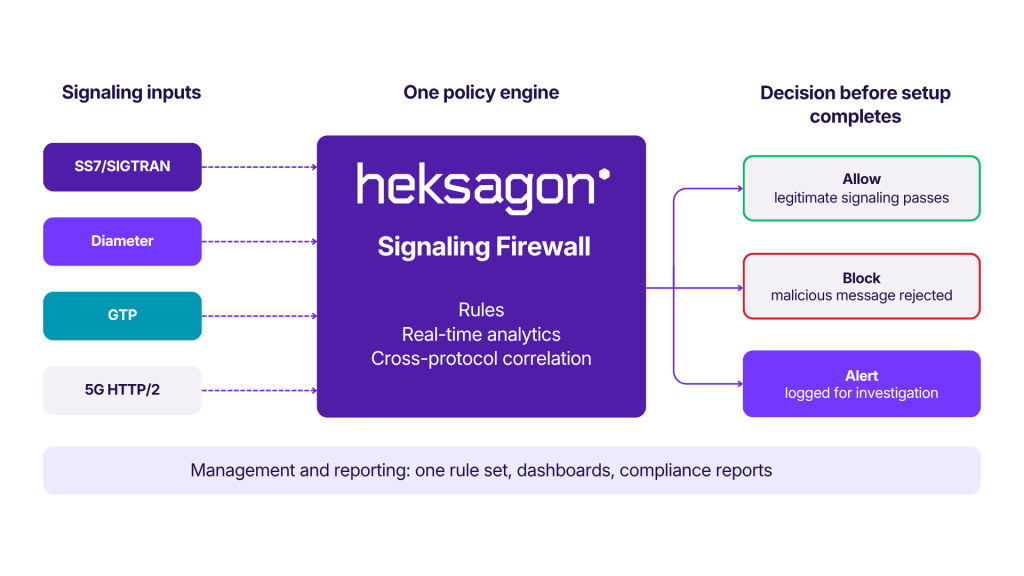
A unified Signaling Firewall applies consistent detection and enforcement across SS7/SIGTRAN, Diameter, GTP, and SIP from a single policy layer. It also lines up with the GSMA's per-protocol firewall guidelines, FS.11 (SS7), FS.19 (Diameter), and FS.20 (GTP), and it pays off in three ways.
- Correlated detection across protocols turns individually ambiguous signals into actionable events.
- Real-time decisioning at the signaling layer means fraudulent or malicious sessions are blocked before call setup completes, not identified in a post-event report.
- Consistent policy across every protocol eliminates the coverage gaps that per-protocol point solutions leave open.
Heksagon's Signaling Firewall is built this way. It covers MAP, CAMEL, and ISUP for 2G/3G SS7 networks, Diameter across S6a, S6d, SLh, and all Diameter interfaces, GTP tunnel-level protection on Gn, Gp, and S5/S8, and 5G HTTP/2 for the service-based core, with cross-protocol correlation across all of them and preconfigured rules for GSMA FS.11, FS.19, and Category 1 to 3 threats. SIP-layer threats such as CLI spoofing and voice DDoS are handled by Heksagon's Voice Firewall, which inspects SIP call setup before the call connects and supports STIR/SHAKEN, national and regional validation schemes, and Heksagon's own call validation. Deployment can start in monitor mode, testing rules on live traffic before anything is blocked.
Does Your Signaling Security Cover Every Path?
These protocols are being exploited now. The question is whether your controls cover every signaling path your network exposes.
If you secure SS7, Diameter, GTP, and SIP as separate domains, a coordinated attacker can work the blind spots between them. To see exactly which cross-protocol attacks your current controls miss, and close those gaps under one policy, let's get in touch.